volto-listing-block

Volto add-on
Features
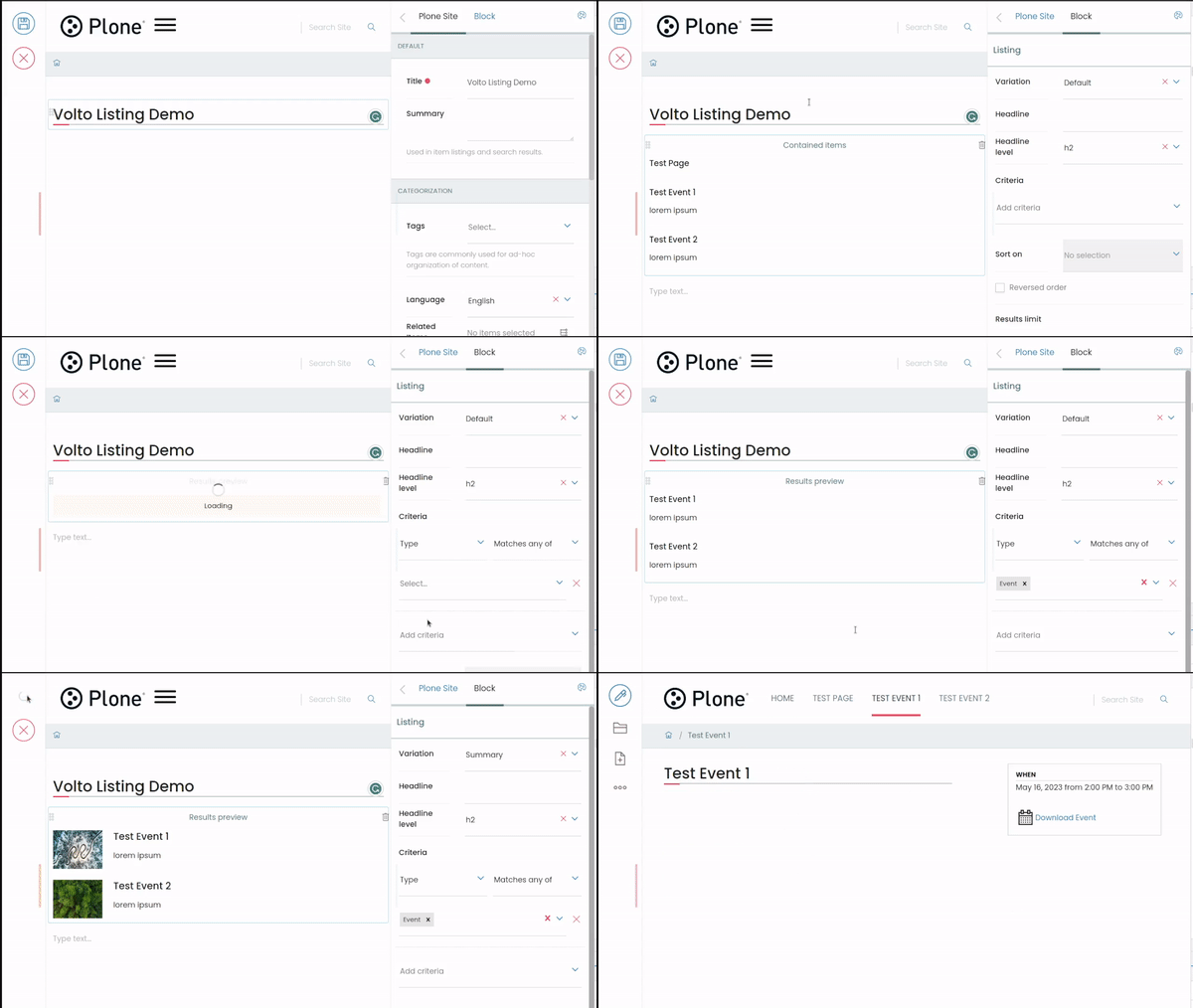
This package aims to provide a framework for more flexible listings for the Listing Volto block. It introduces the concept of UniversalCard, which is a generic component governed by a designated "itemModel".
It provides several views and integrates with the Teaser Grid.
Upgrade
Upgrading to 11.x
Version 11 replaces the many card templates and listing variations with two card templates and a set of controls. Existing content is migrated on the fly, so there is no upgrade step to run in Plone.
What changed
Layouts. The listing block offers four layouts: List (summary, now the
default), Grid (cardsGallery), Carousel (cardsCarousel) and Accordion. The
layout picks the card template: List uses the list item, Grid and Carousel use
the card.
Card templates. Only Card and List item are left. Every former template is now a combination of their controls:
Former template (itemModel['@type']) | Now | Controls |
|---|---|---|
card | Card | image on top |
imageOnLeft / imageOnRight | Card | image on the left / right |
imageCard | Card | content mode: image only (title on image) |
imageOnBottom | Card | content mode: title and logo |
visualizationCard | Card | visualization elements order, benchmark level |
item | List item | image on the left / right / none |
searchItem | List item | content type and date above the title |
simpleItem | List item | size: compact (title only) |
The Visualization Cards layout (cardsVisualization) becomes a Grid with five
columns and the "Top accent border" card style.
Card controls.
- Card elements (List item elements for the list): one control that lays out the metadata of the card. Drag the elements (image, content type, date, title, benchmark level, description, tags, call to action) to reorder them, switch them on or off, and expand them for their settings, e.g. the event date, the title and description max lines, the icon or the call to action label and URL.
- Content mode (card): image and content, image only (title on image) or title and logo (teasers).
- Image position: top, left, right or none. Grid and Carousel cards only offer top.
- Flip card: the card turns over on hover or keyboard focus. Each element chooses its side in the card elements.
- Size (list item): default or compact (title only).
- Border (styling): no border, top accent border (cards) or bordered.
How the content is migrated
The migration is a JavaScript function
(src/components/UniversalCard/migrate.js for the card model,
src/blocks/Listing/variations.js for the listing and search layouts), not a
Plone upgrade step:
- View: the blocks are migrated in memory on every render, the stored data is not changed. Pages render the same as before the upgrade.
- Edit: when a listing, search or teaser block is selected, its data is rewritten to the new model and the controls show the migrated values.
- Save: saving the page stores the migrated data. Pages that are never edited keep the old data and keep being migrated on the fly.
Data that is already migrated is left unchanged. Volto's own listing templates and the Image Gallery stay available only for the blocks that already use them. Blocks saved with a variation that is not registered anymore keep Volto's default list, as do search blocks without a results layout.
How to upgrade
-
Update the add-on in your project's
package.jsonand runyarn:"dependencies": { "@eeacms/volto-listing-block": "^11.0.0" } -
Update the customizations (shadows) and imports of the removed modules:
blocks/Listing/item-templates/CardTemplates.jsx,ItemTemplates.jsx,SearchItemTemplate.jsx,SimpleItemTemplates.jsxandVisualizationCard.jsx, replaced byCardTemplate.jsxandItemTemplate.jsxblocks/Listing/layout-templates/VisualizationCards.jsx, replaced byGallery.jsx
-
Card templates registered by other add-ons in
config.blocks.blocksConfig.listing.extensions.cardTemplatesare not migrated and keep rendering themselves. Check that they still look right with the new layouts. -
Check a few pages with listings, search results and teasers: open them in edit mode, select the blocks, check the card controls and save.
Upgrading to 1.x
This version requires: @plone/volto >= 16.0.0.alpha.15 (volto-slate part of Volto Core).
Getting started
Try volto-listing-block with Docker
  git clone https://github.com/eea/volto-listing-block.git
  cd volto-listing-block
  make
  make start
Go to http://localhost:3000
make start now defaults to Volto 18. To run the same setup against Volto 17, use:
  VOLTO_VERSION=17 make
  VOLTO_VERSION=17 make start
Add volto-listing-block to your Volto project
-
Make sure you have a Plone backend up-and-running at http://localhost:8080/Plone
docker compose up backend -
Start Volto frontend
-
If you already have a volto project, just update
package.json:"dependencies": { "@eeacms/volto-listing-block": "*" }
and volto.config.js:
const addons = ['@eeacms/volto-listing-block'];
-
If not, create one with Cookieplone, as recommended by the official Plone documentation for Volto 18+:
uvx cookieplone project
cd project-title
-
Install or update dependencies, then start the project:
make installFor a Cookieplone project, start the backend and frontend in separate terminals:
make backend-start
make frontend-start
For a legacy Volto 17 project, install the package with
yarnand restart the frontend as usual. -
Go to http://localhost:3000
-
Happy editing!
Release
See RELEASE.md.
How to contribute
See DEVELOP.md.
Secret Scanning
This repository uses the Betterleaks GitHub Action to scan the current
repository content on every push and pull request. The scan uses the rules in
.gitleaks.toml and uploads a betterleaks-report artifact when a finding is
detected.
If the optional SMTP secrets are configured, failed scans also send an email to the last commit committer. The workflow expects these repository or organization secrets:
SMTP_URLSMTP_PORT(optional, defaults to25)SMTP_EMAILSMTP_PASSWORD(optional if the SMTP server does not require authentication)
Port 465 is sent with direct TLS; other ports use the default SMTP handshake.
The email includes a short finding summary from the redacted Betterleaks report,
including the redacted matched line from each finding.
There are three common outcomes:
-
Everything is OK. The
Betterleaks / Scan for secretscheck is green and no action is needed. Regular references to runtime values are OK, for example:const tokenFromCookie = req.universalCookies.get('auth_token'); -
A real secret was found. The check is red and the workflow log asks you to download the
betterleaks-reportartifact. Open the artifact from the GitHub Actions run and check the reported file, line and rule. Remove the committed value, move it to the proper secret store, and rotate it if it was exposed. A report entry looks like this:{ "RuleID": "secret-literal-assignment", "File": "src/config.js", "StartLine": 12, "Secret": "[REDACTED]" } -
The finding is a false positive. Keep the value only if it is clearly not sensitive, such as a test fixture, placeholder, or public example. Add
betterleaks:allowon the same line and include a short explanation in the pull request.const testPassword = 'admin'; //betterleaks:allowpassword: "admin" #betterleaks:allow
Do not add betterleaks:allow to real credentials.
Copyright and license
The Initial Owner of the Original Code is European Environment Agency (EEA). All Rights Reserved.
See LICENSE.md for details.