Kerno: Catch breaking backend changes and unintended side effects before raising a PR
AI tools generate backend code fast, but you still need to verify it actually works.
Kerno is a validation engine that helps you catch breaking changes in your AI backend code before raising your PR. It automatically generates, runs, and maintains high-quality integration with full codebase context.
When you make changes, Kerno validates them against your real service and dependencies to catch breaking changes and unintended side effects. All directly in your terminal or IDE with instant feedback.
Installation
Run on demand with npx (no install):
npx @kerno/cli init
Or install globally:
npm install -g @kerno/cli
kerno init
Requires Node.js 18+.
Connect to Claude Code or Cursor
kerno init starts the Kerno agent (if not already running) and prints the MCP server configuration for your AI coding assistant.
Claude Code — run the command Kerno prints:
claude mcp add --transport http kerno http://localhost:<port>/mcp
Cursor — copy the printed snippet into .cursor/mcp.json:
{
  "mcpServers": {
    "kerno": {
      "url": "http://localhost:<port>/mcp",
      "transport": "http"
    }
  }
}
Once connected, your AI assistant can drive Kerno to generate, run, and validate integration tests against your real stack.
Commands
| Command | Description |
|---|---|
kerno audit | Audit what AI-assisted development did to this repository |
kerno init | Start the agent and show MCP config for Claude Code and Cursor |
kerno stop | Stop the Kerno agent |
kerno status | Check system status |
kerno logs | Stream workspace logs from the running agent |
kerno login | Log in to Kerno |
kerno logout | Log out from Kerno |
kerno uninstall | Stop the agent and remove installed binaries |
Run kerno with no arguments to launch the interactive shell, or kerno --help to see all options.
Global options
| Option | Description |
|---|---|
-w, --workspace <path> | Workspace path (defaults to current directory) |
-v, --verbose | Show Kerno diagnostic logs |
--force-update | Force re-download of the agent (applies to start and mcp) |
-V, --version | Show version number |
-h, --help | Show help |
kerno audit
Gated by the PostHog feature flag
kerno-audit(@kerno.io emails, on inenv=dev, off inenv=prod). The CLI sendsenvat flag evaluation fromBACKEND_URL. Log in with a flagged account; otherwiseauditis unknown.
Reads your git history and reports what changed after AI coding agents arrived. Read-only, no checkout of your repository disturbed. Minutes for a normal repository. Computed locally except the judge, which sends small source extracts to TypeSafe's decision API — see How the judge works.
cd your-repo
kerno audit
It asks two questions, because neither can be answered reliably from the repository alone:
- When did AI coding agents arrive? It proposes a month from agent
identities and
Co-authored-bytrailers, shows the evidence it used, and takes your correction. If its two detection rules disagree with the history, it says it cannot date adoption rather than inventing a month. - How much history should the comparison use? Twelve months by default. Six has given the opposite sign to twenty-four on a real repository, so prefer twelve or more.
Then it reports, with the named functions and commits behind each one:
- Reimplementation — functions written that the codebase already had.
- Complexity — branching per change, measured against the repository's own prior trend rather than a bare before/after. A result that trend already explains is marked confounded and kept out of the headline.
- Rework — later commits that rewrite a recent commit's code, and how long a change survives before it is first rewritten.
A commit with no AI trailer is reported as unknown, never as human: the AI
figure is a floor on involvement, not a measurement of it. The audit does not
measure defects — it reads git, never a bug tracker, so it can neither
confirm nor deny anything about AI and bug rates.
| Option | Description |
|---|---|
--root <path> | Repository to audit (default: current directory) |
--adoption <YYYY-MM|auto|none> | Set the month, accept the detected one unattended, or run with no comparison |
--baseline <3|6|12|24> | Months of history before adoption to compare against |
--plugins <a,b> | Run only these metrics |
--budget <usd> | Hard cap on model spend for the run |
--trace-judge | Record every model request and answer in full, for review |
-y, --yes | Accept every default; never prompt |
The report lands in ~/.kerno/audit/runs/<name>/report.md.
How the judge works
Where a measurement is genuinely undecidable by static analysis, one closed question about one pair of things goes to a model — two function bodies, or a commit-message pair and one file's diff. It never scores a whole change and never searches your code.
Those questions go to TypeSafe's decision API, which runs on OpenAI models, reached through Kerno's Bifrost gateway and billed to your organization. Source from this repository therefore leaves your machine. Per run, at most:
| Sent | Volume | Why |
|---|---|---|
| Pairs of function bodies | 80 requests, 40 lines of source per function | Tell a reimplementation from a coincidence |
| A commit-message pair plus one file's diff | 120 requests, 8,000 characters of diff each | Tell a repair from an extension |
A commit diff (only with --enable complexity-judge) | 60 requests, 12,000 characters each | Tell a justified complexity increase from an avoidable one |
Those are ceilings; --budget usually binds first. The caps themselves live in
the plugins — MAX_JUDGED and MAX_QUOTE_LINES in plugins/duplication,
MAX_JUDGED and DIFF_BUDGET in plugins/followups and plugins/complexity —
so this table has to be re-read against them when they change.
A diff is raw git diff output, so it carries its diff --git a/<path> and
---/+++ headers: repo-relative file paths go with it, as do the commit
messages. Whole files, the repository name and the codebase index do not.
If TypeSafe rate-limits part-way through a run, or the account it bills has
run out of credit, the remaining questions go to an OpenAI decision model
instead, through the same gateway and billed the same way. Neither a 429 nor an
empty balance is a verdict, and without a fallback the run reports unjudged
for everything it did not get to — measuring our concurrency and our billing
rather than your repository. A rate limit diverts for a minute and then tries
TypeSafe again; an empty balance diverts for the rest of the run, because
nobody tops up a balance in the time an audit has left. Fallback answers are counted separately in the report and
marked fallback in the ledger and trace, so a stand-in verdict is never
mistaken for a primary one. OPENAI_API_KEY overrides the gateway with your own
account; AUDIT_FALLBACK_MODEL picks a different model.
--trace-judge records every request and reply verbatim under the run
directory, so you can read exactly what was sent rather than take this on trust.
To judge nothing at all, pass --budget 0, or run without a Kerno session —
every judged measure then reports itself as unjudged rather than guessed.
When a report says nothing was read
The audit parses with tree-sitter grammars that ship inside codegraph's package
for your platform, and reads codegraph's index through node:sqlite, which
needs Node 22. Both fail quietly: a grammar that is not installed is a
legitimate state, so the run succeeds and every number is computed from a tree
it never read.
kerno audit --doctor
checks each one directly — it installs codegraph if missing, indexes a throwaway repository and reads the index back, then parses a sample function with every configured grammar — and exits non-zero if anything is broken.
  ok    node:sqlite          available on v22.22.2
  ok    codegraph            ~/.kerno/audit/tools/node_modules/.bin/codegraph
  ok    codegraph index      1 symbols read back
  ok    tree-sitter grammars 16 ready: typescript, tsx, javascript, python, ...
How It Works
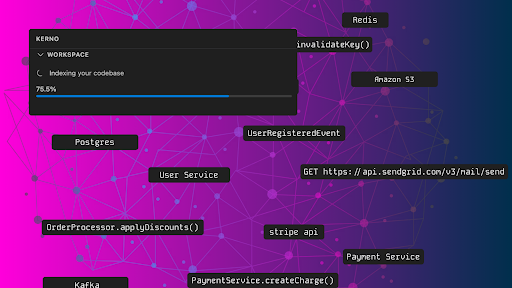
1. Codebase indexing
Kerno indexes your codebase to build a deep understanding of how everything works together. Kerno supports TypeScript, JavaScript, Python (Go, PHP, Ruby, Java coming soon).
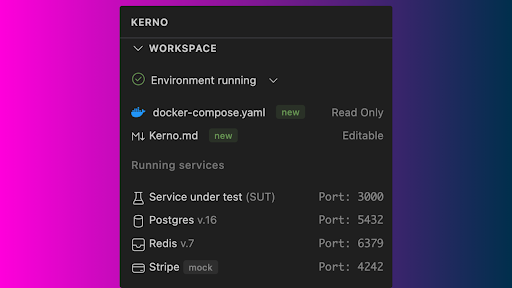
2. Zero-config environment orchestration
Kerno automatically orchestrates your application and its dependencies (PostgreSQL, Redis, MongoDB, Kafka, RabbitMQ, and more) locally with zero manual configuration.
"Kerno was up and running in minutes with no manual work, and it made our API migration so much smoother. We could instantly validate that every change made by Cursor worked the way we expected, and now it's a core part of how we build." — Misch Strotz, Co-Founder & CEO, Letz AI
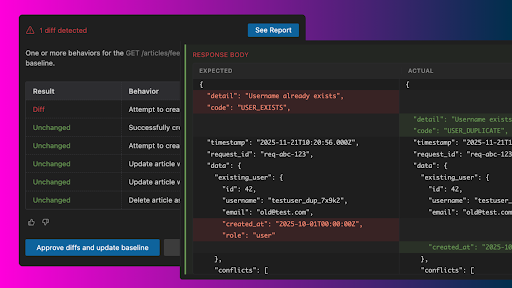
3. Baseline Capture & Diff Detection
Kerno captures the baseline behavior of critical paths for your REST endpoints, then compares your code changes to the baseline and flags any diffs.
What Kerno validates:
- Functional API workflows
- Contract & schema validation
- Error handling & resilience
- Authorization & authentication
- Boundary & edge cases
"Kerno saves us a lot of manual work and helps us catch side effects and issues that would definitely break our projects' backends. Our engineering team loves it." — Santiago J. Valls, Co-Founder & CTO, BeWise
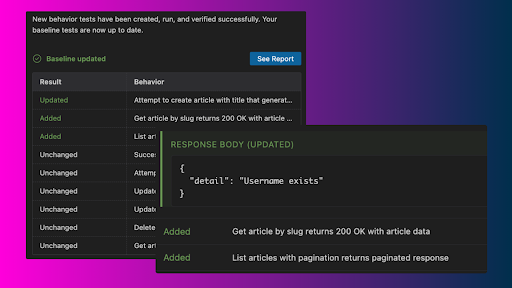
4. Self-Healing Maintenance
As your app evolves, Kerno updates your tests to keep everything in sync without manual effort. Tests are added as features appear and retired as code changes—keeping your suite complete and consistent.
Why Teams Choose Kerno
- 35% fewer breaking backend changes and unintended side effects
- 3X faster feedback loops for developers, leading to fewer PR bottlenecks
- 10+ hours saved each week per developer troubleshooting integration issues post-CI
"Using Kerno with Claude Code has been a game changer. You get quick feedback with no manual effort, and it saves you a lot of time and hassle debugging integration issues post-merge." — Jonathan Bernales, CTO, Germen
Security & Privacy
- The codebase index is stored locally – Indexing is local and the index
itself stays on your machine.
kerno auditis the exception: when a measurement cannot be settled statically it sends source extracts, with the file paths in their diff headers, to TypeSafe's decision API — see How the judge works for exactly what and where. - Never used for training – Your private code is strictly off-limits
- Enterprise security – SOC 2 Type II compliance in progress
- Encryption – TLS 1.2 in-transit, AES 256-bit at-rest
What kerno audit collects
The first audit on a machine shows this on screen and asks before anything
runs. The answer is kept in ~/.kerno/audit/sharing.json; kerno audit --data-sharing asks again.
Uploading the run, with the quoted code behind each finding, is the default — including where there is no terminal to show the disclosure on, such as CI or a coding agent. Opting out is a flag away and the flags are listed below, but a pipeline that nobody has configured will send results and source to the organization it is signed in as. A run with no Kerno session uploads nothing, because it has nowhere to send it.
| Where | What | When |
|---|---|---|
| This machine | The repository, read with git. The report, caches and every run artefact, under ~/.kerno/audit. | Always |
| The model provider, via Kerno | One small extract per question: a function body, a single commit's diff, a commit message. Billed to your organization, never used for training. | Only with the judge on |
| Kerno | Measurements and monthly series, plus the detail behind them — file paths, commit ids and messages, the author names and emails already in your git history, and the quoted function bodies behind each finding. | By default |
| Flag | Effect |
|---|---|
--no-evidence | Upload the run, but strip the quoted function bodies from it |
--no-upload | Measure and report locally; send nothing to Kerno |
--no-judge | Keep code away from the model; judged measures read unjudged |
--local | All of the above at once — nothing leaves this machine |
--data-sharing | Show the disclosure and choose again |
Every upload records how many quoted bodies it stripped, so "the source was removed" is a number rather than a promise. How long an upload is kept and how to have it deleted are in Kerno's privacy policy.
Requirements
- Node.js 18+
- Docker: Kerno uses Docker to create isolated environments for test execution. Please ensure Docker Desktop is installed and running on your local machine.
- Git: Kerno only supports Git repositories. Make sure your project is initialized with Git.
Learn More
- Documentation: https://kerno.gitbook.io/docs/
- Website: https://kerno.io
Questions? Join the Kerno Discord community.